

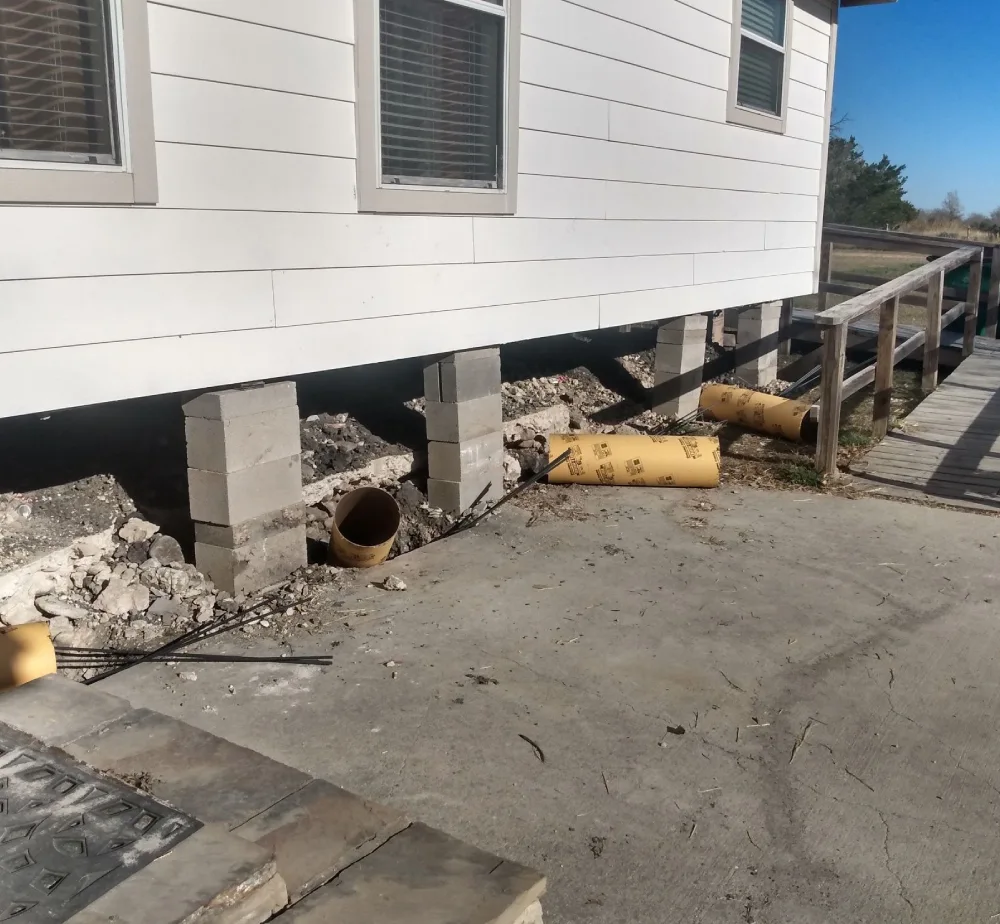
Dallas-Fort Worth homeowners face foundation challenges unlike anywhere else in America. The region’s notorious Blackland Prairie clay soil that swells after rain and contracts hard during drought puts constant stress on residential foundations year-round.
After inspecting thousands of homes across Frisco, Dallas, Plano, and Fort Worth, here are the seven foundation problems we see most often, what causes them, and what fixing them actually involves.
Problem 1: Slab Foundation Settlement
What it looks like: Uneven floors, cracks near doorways, doors that stick, gaps between walls and ceilings.
What causes it: Soil under one section of your slab dries out or erodes, leaving that section without support. The slab drops on that side while the rest stays in place creating differential settlement. Texas A&M AgriLife Extension notes that DFW’s Blackland Prairie clay is among the most expansive in North America, making differential settlement especially common here.
The fix: Steel push piers or helical piers are driven deep beneath the affected sections until they reach stable soil or bedrock. The foundation is then hydraulically lifted back to its original elevation. This is a permanent fix and most reputable companies offer a lifetime transferable warranty.
Problem 2: Pier and Beam Foundation Failure
What it looks like: Bouncy or soft floors, visible sagging in the center of rooms, musty smell from the crawl space.
What causes it: Wood beams and piers beneath older DFW homes (typically pre-1980 construction) deteriorate from moisture, wood rot, termite damage, or simply age. When a center beam weakens, the floor above sags.
The fix: Damaged wood beams are sistered or replaced. Rotted wood piers are swapped for adjustable steel piers. Crawl space encapsulation and proper ventilation are added to prevent recurrence.
Problem 3: Foundation Drainage Problems
What it looks like: Water pooling near your foundation after rain, efflorescence (white mineral deposits) on your foundation walls, wet crawl space.
What causes it: Gutters draining too close to the house, negative grade (yard sloping toward the home), or no drainage system at all. Standing water near your foundation saturates soil unevenly and accelerates settling. FEMA’s guidelines on residential drainage recommend a minimum 6-inch drop over the first 10 feet away from any structure.
The fix: French drains or surface drains redirect water away from the foundation. Downspout extensions move gutter discharge at least 6 feet from the structure. This is often the most cost-effective thing a DFW homeowner can do.
Problem 4: Plumbing Leaks Under the Slab
What it looks like: Unexplained increase in your water bill, hot spots on your floor, the sound of running water when all fixtures are off, foundation cracks that appear suddenly.
What causes it: DFW’s clay soil shifts and contracts, putting stress on slab plumbing. Over time, pipe joints crack or pull apart. Water erodes the soil under your slab from the inside.
The fix: A hydrostatic plumbing pressure test identifies the leak location. Depending on severity, pipes are either re-routed through the walls (avoiding the slab) or accessed through tunnel excavation under the slab. Addressing the leak before repairing the foundation is critical — repairing a foundation over an active leak is money wasted.
Problem 5: Foundation Heaving
What it looks like: Floors buckling upward, doors that won’t close because the frame has risen, cracks that run along the center of a slab.
What causes it: The opposite of settling heaving happens when soil under part of your foundation swells excessively, usually from a plumbing leak or after heavy rainfall following a drought. This is more common in DFW than most regions because of the clay soil’s extreme expansion capacity.
The fix: Heaving cannot be fixed by adding piers you must first identify and eliminate the moisture source causing the soil expansion. After the soil normalizes, the foundation is reassessed. In some cases, interior drainage channels are added.
Problem 6: Bowing or Cracked Foundation Walls
What it looks like: Horizontal cracks on foundation walls, walls that visibly lean inward, stair-step cracks in brick or block.
What causes it: Lateral soil pressure the ground pushing against your foundation wall from the outside. This is especially common in areas with poor drainage where saturated soil builds up hydrostatic pressure.
The fix: Carbon fiber straps are anchored to the wall and floor system, preventing further movement. For severe bowing, wall anchors are drilled through the soil and connected to a stable plate in the yard, then gradually tightened over time to straighten the wall.
Problem 7: Tree Root Damage
What it looks like: Cracks that appear near large trees, uneven settling on the side of the house closest to a tree, roots visible near the foundation.
What causes it: Large trees especially fast-growing species like live oaks, elms, and willows common in DFW draw enormous amounts of moisture from the soil. The soil under your foundation dries and contracts near the tree, while the opposite side stays stable.
The fix: Root barriers are installed to redirect root growth away from the foundation. In severe cases, the tree may need to be removed. The affected foundation section is then stabilized with piers.
The Common Thread: Get It Inspected Early
Every one of these problems is significantly cheaper to fix when caught early. A 3-pier repair today can become a 12-pier repair two years from now if ignored.
At Top Level Foundation, every inspection is completely free. We’ll tell you exactly what we find even if the answer is “come back in a year.”
Also read: Foundation Cracks When to Worry and When You’re Fine
Frequently Asked Questions
How do I know if my foundation problem is urgent?
Horizontal cracks, rapidly growing cracks, water intrusion, or sudden floor sloping are all signs requiring immediate attention. Stable hairline cracks with no other symptoms can typically be monitored.
How much does foundation repair cost in DFW?
Minor repairs (drainage correction, a few piers) typically run $3,000–$8,000. Major whole-home stabilization projects can reach $15,000–$30,000+. We provide free written estimates with no pressure.
Do I need an engineer's report?
For most lender or insurance purposes, yes. Top Level Foundation can coordinate an engineer’s report as part of your repair process.
s foundation repair work licensed in Texas?
Yes. Texas requires foundation repair contractors to hold a license through the Texas Department of Licensing and Regulation (TDLR). Always verify before signing any contract.